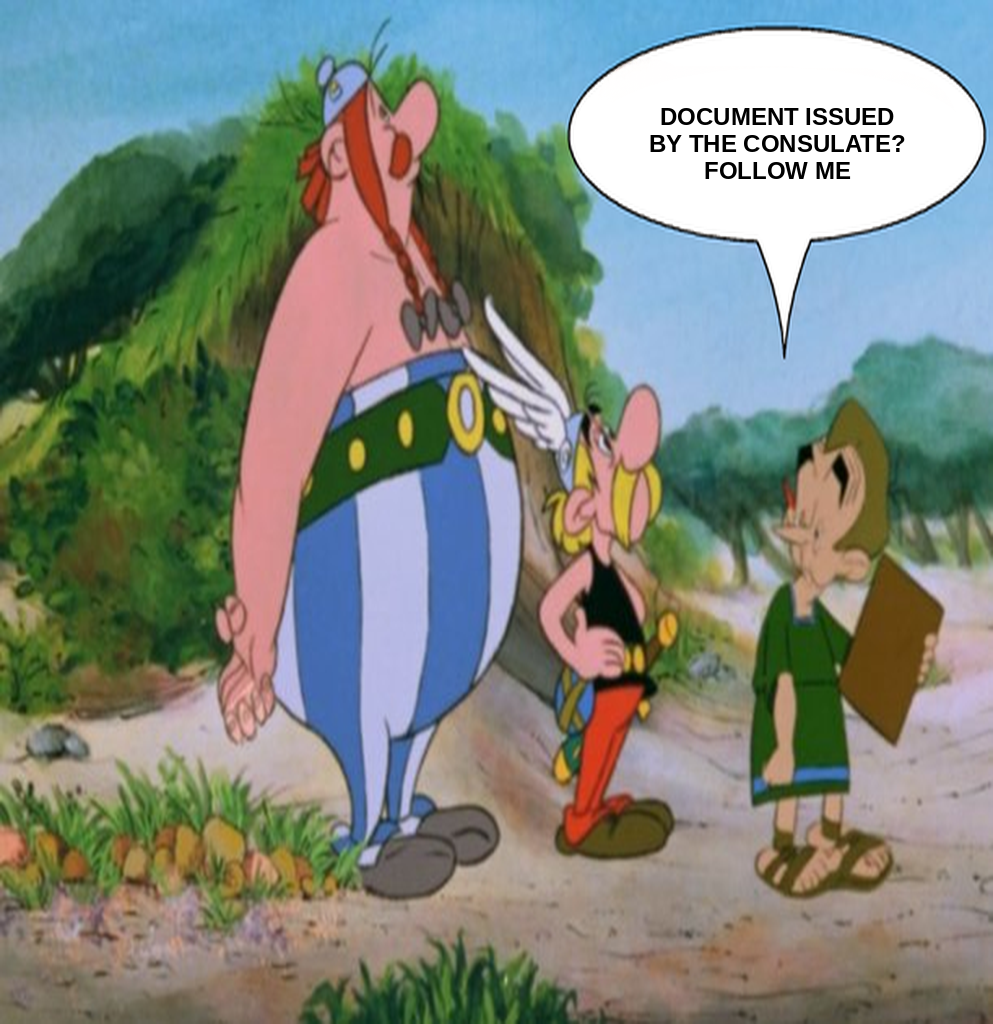
Apostilles and the legalisation of documents: a guide to navigating international bureaucracy – a mission worthy of Obelix
There is an episode in the Asterix series where Obelix enters the so-called ‘House that Sends You Mad’: a place where every door seems to be the right one, every corridor suggests a way out, and yet you always find yourself at the start of another passage, as if bureaucracy were taking real pleasure in causing you go round in circles, in a way that means your never know exactly where you are headed.
Anyone who has ever had to deal with documents for abroad is all too familiar with this feeling.
When a simple document becomes an obstacle course
It all starts off simply enough. You have a birth certificate, a degree, or a notarial deed in your hand. An official document, unquestionably valid, that just has to be handed over. So it is you present it, but someone rolls their eyes and says: ‘It’s missing the Apostille.’ It seems just a formality, little more than a fancy stamp. Then they add, as casually as if ordering a coffee: ‘Or legalisation.’ And this is where the document ceases to be a document and becomes the start of a bureaucratic adventure, with a series of hurdles stretching out before you.
Apostille, Prefecture, Public Prosecutor’s Office or Consulate? the questions multiply
From this moment on, a succession of questions begins to emerge, never all at once but one relentlessly following another. It is a journey. You are left wondering whether you should go to the Prefecture first or the Public Prosecutor’s Office first. When does the Consulate come into play, before or after these? If the document has a digital signature, does that change anything? Can you sort it all out online or do you have to go to an office in an actual building? And if the document is, say, Moldovan but you find yourself in Italy, where do you get the Apostille, here or in the country of origin? Each question seems in itself straightforward, until that is you become aware that every answer opens another door, just as one closes behind you.
And there’s the rub. As you try to work out where you need to go, you find that there is never just one ‘where’. Everything changes depending on the country, on the document in question, and the use to which you intend to put the document. As you search for some logic in the system, what keeps coming back is the disarming and calmly repeated phrase: ‘it depends.’ It depends on the country, it depends on the document, it depends on the authority receiving it; it depends on a series of variables that turn a normal sheet of paper into a puzzle that has be analysed, rather than simply filled in.
As for the document itself, it changes its nature despite any action one your own part. It is no longer just a piece of paper. It is by now something that has to be checked, verified, translated, certified and then verified, and then stamped all over again, as if each step was just to confirm that the previous step was genuine or authentic. Each office sends you to another office, and at every counter you happen upon they explain that you have to something else first. Every answer raises a new question. Each time you feel you are finally at the door that leads you out of the process, you find it opens to another corridor with a new exit door at its end.
Sworn and certified translation: finally a stage that seems straightforward; but isn’t
Then comes the translation, which at first seems like the simple part. ‘Just translate it,’ you think. But even there you discover that translation alone isn’t enough: the translation must be sworn, certified and, in some cases, goes through the same cycle of stamps and checks that seem to multiply according to no obvious logic. What if you already have a translation done by an embassy or a consulate? Is that sufficient? No, it isn’t.
Just as you think it is finally over, here you go again: the requirement for an Apostille or consular legalisation. It’s as if there is someone moving the finishing line, not by much each time, but just enough to make it seem perpetually out of reach.
At this point Obelix loses his patience in the ‘House that sends you mad’, where corridors all look the same, doors that never lead to an exit. The latter-day Gaul turns to the internet, Google or AI, hoping for a clear and immediate answer. In little more than the blink of an eye, he finds himself inundated with international regulations, consular procedures, technical explanations, exceptions, agreements between states, and rules that change depending on the document.

Globostudio: the solution to the ‘House that Sends You Mad’
This is where Globostudio comes in. It makes no sense to have to become an expert in Apostilles, legalisation, certified translations, Prefectures, Public Prosecutors’ Offices and Consulates just to submit a document abroad. We do this every day. We know which steps are necessary, which are unnecessary and, above all, the mistakes that have to be avoided. In every case a precise and well-oiled process is put into motion, avoiding wasted time, unnecessary steps and shuttling between offices that seem identical but follow different procedures. The aim is simple: to achieve the result in the shortest possible time, without the risk of being told, at the end of the process: ‘I’m sorry, a stamp is missing’. The client provides the document, Globostudio deals with the ‘madhouse’.
Do you have a document that needs an apostille, legalisation or translation for use abroad? Contact Globostudio: we’ll find the right process, avoiding all unnecessary detours.
Frequently Asked Questions on Apostilles and the Legalisation of Documents (FAQ)
Do I need to go to the Prefecture or the Public Prosecutor’s Office?
It depends on the type of document and the issuing authority: this is exactly the sort of assessment a professional can make in a matter of minutes, saving you from having to resort to trial and error.
Does the Consulate come into the process before or after legalisation?
It depends on country concerned and the type of recognition required. Generally speaking, the Consulate is the final step needed to complete the process.
If the document has a digital signature rather than a handwritten one, what should I do?
The presence of a digital signature may alter the verification process and the relevant authorities to contact, so it is important to mention this from the outset.
Can I do everything online, or do I have to go to an office in person?
Some stages can be completed digitally, whilst others still require you to visit specific offices in person: the combination depends on the document and the relevant authority.
The document was issued in a foreign country but I am in Italy: where is the Apostille affixed?
Generally speaking, in the country where the document was issued, but the receiving authority may require different procedures.
Is a translation already done by an embassy or consulate sufficient?
No, you need to have a sworn or certified translation carried out to accompany the document.